

When a B2B buyer asks an AI assistant which vendors to shortlist, the answer comes from somewhere. It comes from the sites that assistant trusts, the publications that cover your category, and the pages that get cited when someone asks a hard question about your space.
If your brand isn’t in that pool of sources, you’re not in the answer. And you’re probably not on the shortlist either.
That’s the real job of B2B link building right now. It’s not collecting backlinks for a DR score. It’s becoming the company that search engines, AI systems, and buying committees all associate with a category. We call that category authority, and this playbook shows you how to build it.
We’ll cover why B2B buying makes links matter more than they do in consumer markets, how AI search decides who gets cited, and the four layers of a link building program that turns your brand into the default answer in your category.
A quick note on scope. This post is about category authority for B2B brands. If you’re a SaaS company looking for tactic-by-tactic examples, our SaaS link building guide goes deep on that. If you’re coordinating link building across multiple properties or a large organization, start with our guide to enterprise link building. And for the mechanics of volume and throughput, see how to scale link building.
What Is B2B Link Building?
B2B link building is the process of earning links and citations from the websites your business buyers already trust, so that your brand shows up when those buyers research a category, whether that research happens on Google, inside an AI assistant, or in a trade publication.
That definition has two parts most guides skip.
First, “already trust.” A link from a random blog with a decent DR doesn’t move a procurement committee. A link from the trade journal your buyers read, the expert site they cite in internal decks, or the vendor community they lurk in does.
Second, “when those buyers research a category.” B2B buyers aren’t searching for your brand. They’re searching for the problem. Your links need to attach you to that problem so that when the category comes up, you come up with it.
Why B2B Buying Makes Links Matter More
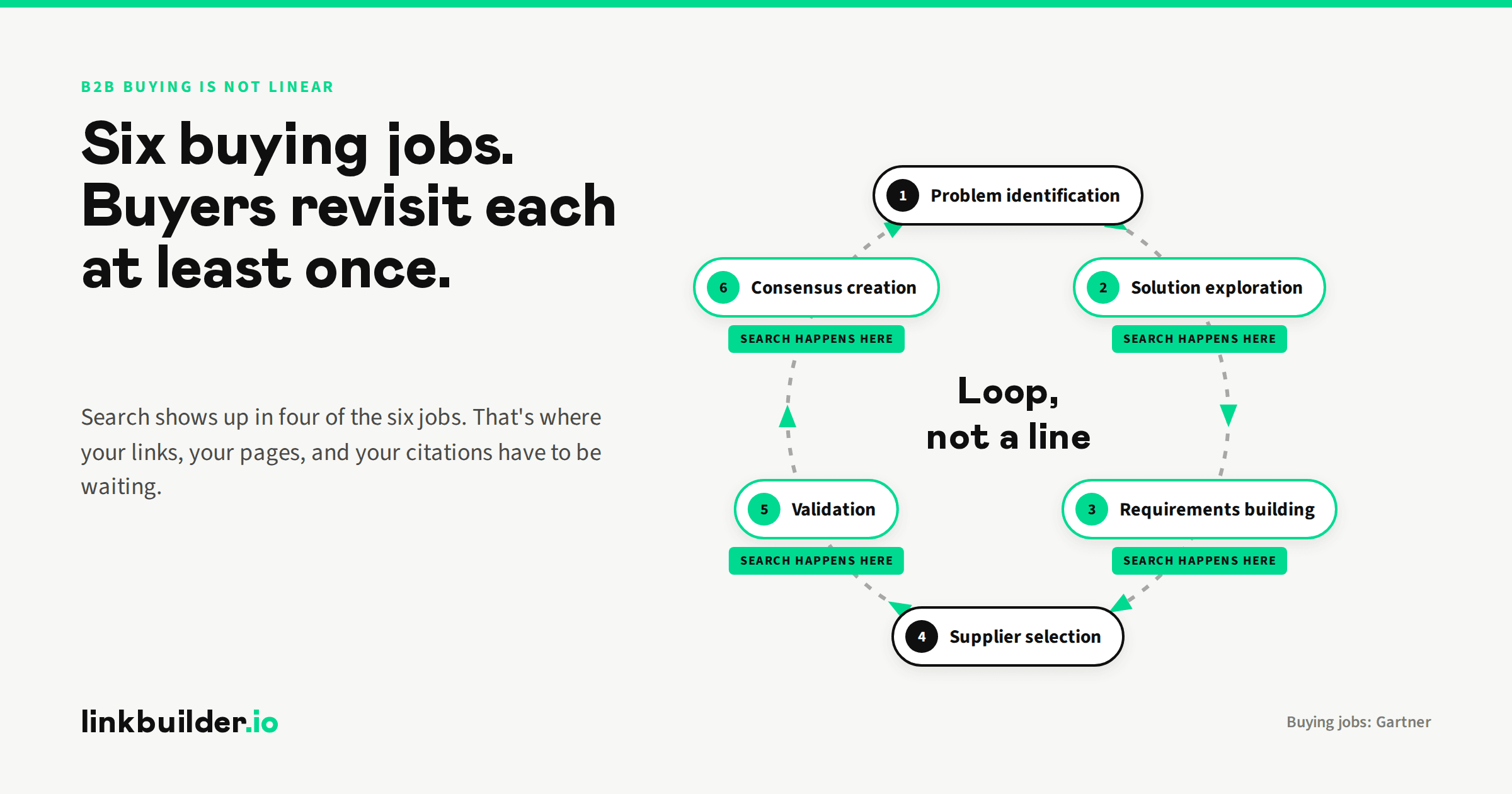
B2B purchases don’t happen in a single session. Gartner’s research on the B2B buying journey describes six distinct “buying jobs” that a buying group works through: problem identification, solution exploration, requirements building, supplier selection, validation, and consensus creation. Buyers loop back through these jobs, revisiting each at least once, and Gartner reports that 75% of B2B buyers prefer a rep-free sales experience.
Read that list again and notice how many of those jobs happen without you in the room.
Solution exploration is a search. Requirements building is a search. Validation is the buyer checking whether the thing they believe is true holds up, which is another search, and increasingly one that happens inside an AI assistant. Consensus creation is a champion forwarding third-party sources to their CFO to prove the pick is safe.
Every one of those moments is a chance for your brand to show up, or not. Links are what put you there. They’re the reason a trade publication mentions you in a roundup, the reason your comparison guide ranks, and the reason an AI assistant has enough corroborating sources to name you with confidence.
That’s a fundamentally different job than B2C link building, where a single high-traffic placement can drive purchases directly. In B2B, links do their work over weeks and across a committee. They have to be in the right places, not just numerous.
How AI Search Decides Who Gets Cited
Here’s the part that changed the math on B2B link building.
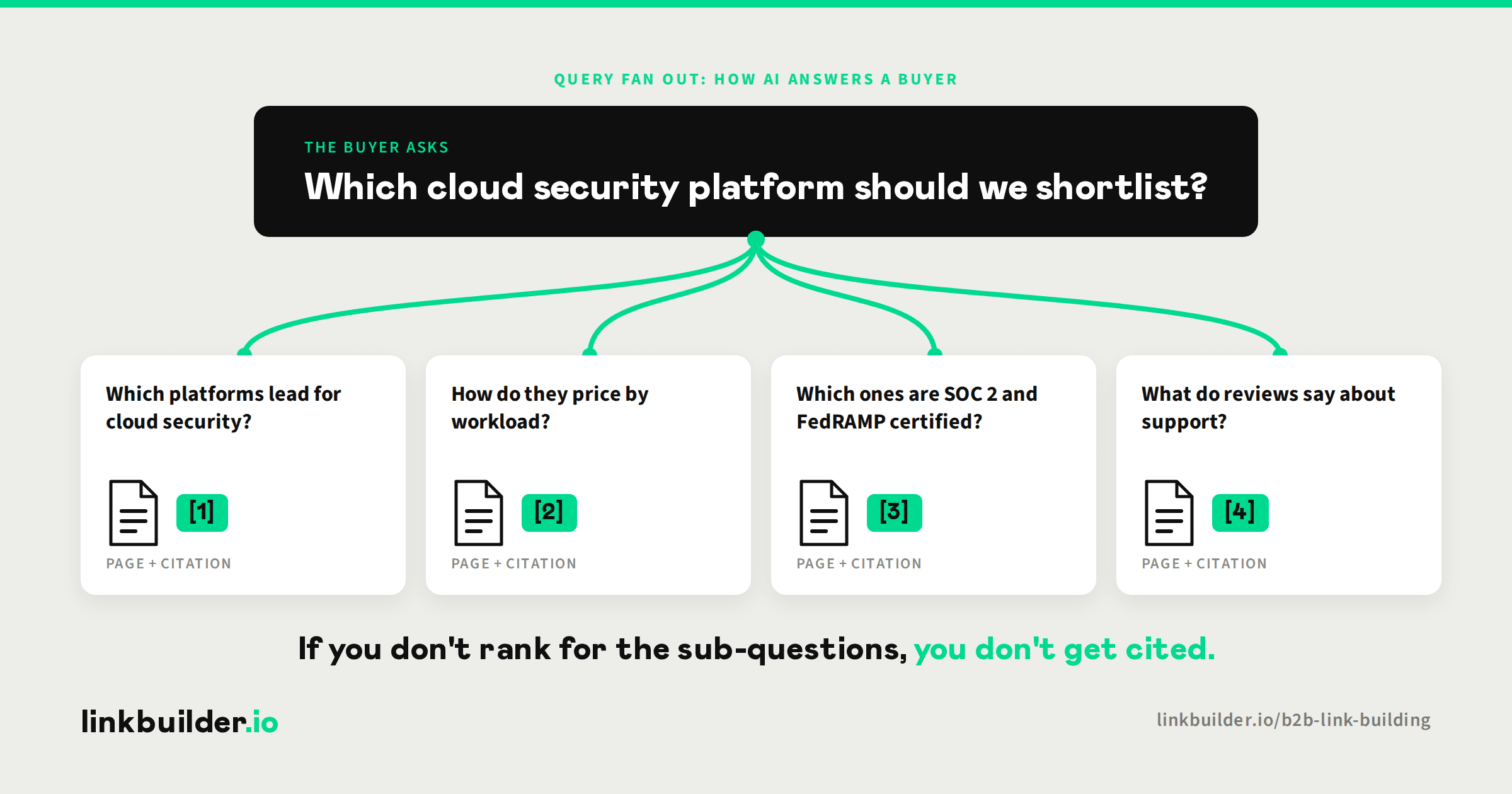
Google’s guide to optimizing for generative AI features explains that AI Overviews and AI Mode use retrieval-augmented generation, meaning they pull from Google’s core search index to ground answers, then show links to the pages that support the response. The same guide describes query fan-out: for a single question, the system generates a set of related sub-queries and fetches results for each one.
Two things follow from that.
One: if you don’t rank for the sub-questions in your category, you don’t get retrieved, so you don’t get cited. Authority still flows through links.
Two: AI systems are looking for corroboration. When multiple trusted sources say the same thing about your brand, the assistant can say it too. Google’s guide is explicit that the content most likely to earn a place in AI features is “non-commodity” content with a unique point of view. It’s just as explicit that chasing inauthentic mentions across the web isn’t the shortcut people think it is.
So the winning move isn’t to get mentioned everywhere. It’s to be the source that the sources cite. That’s category authority, and it’s what the rest of this playbook builds.
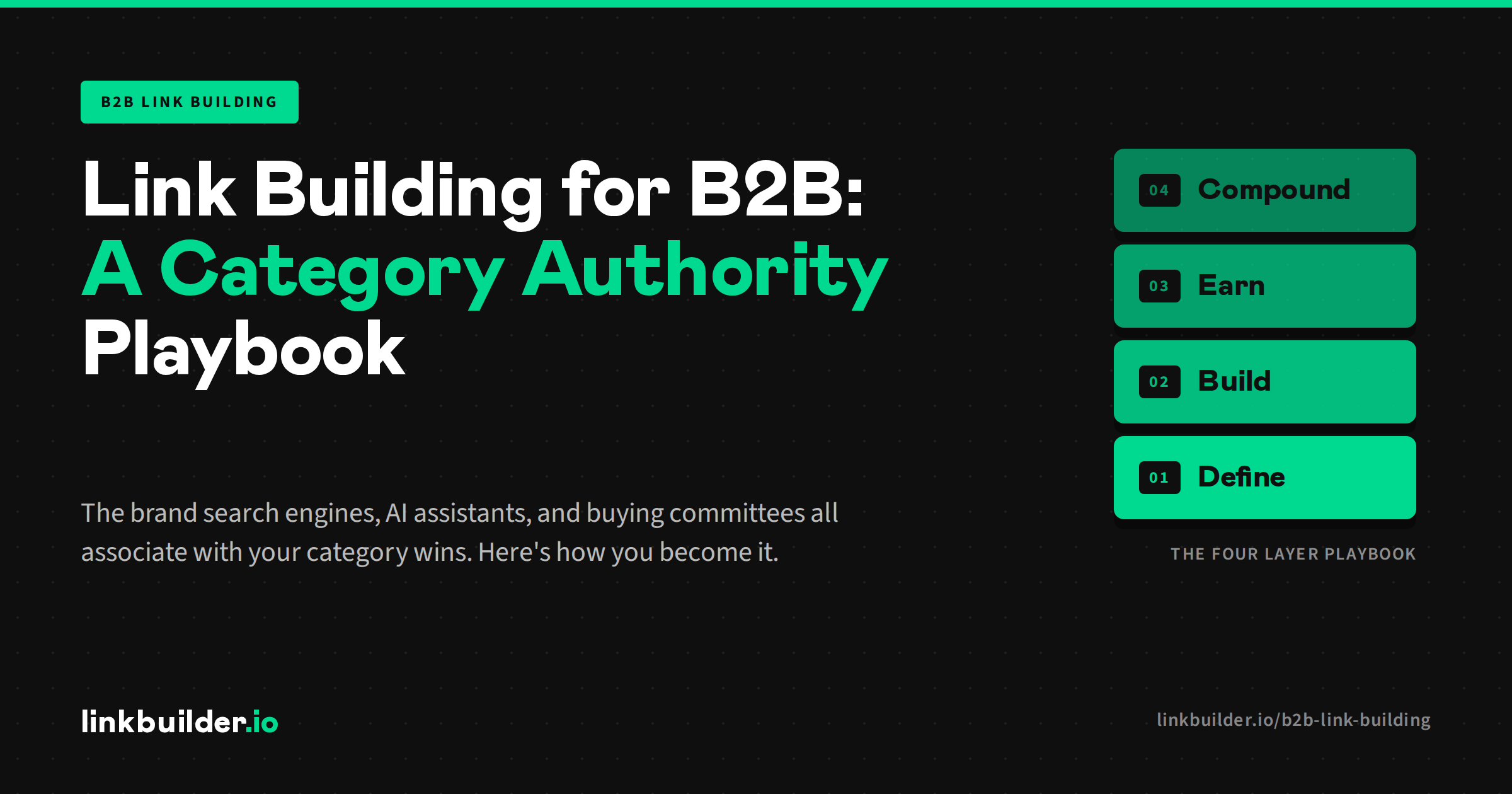
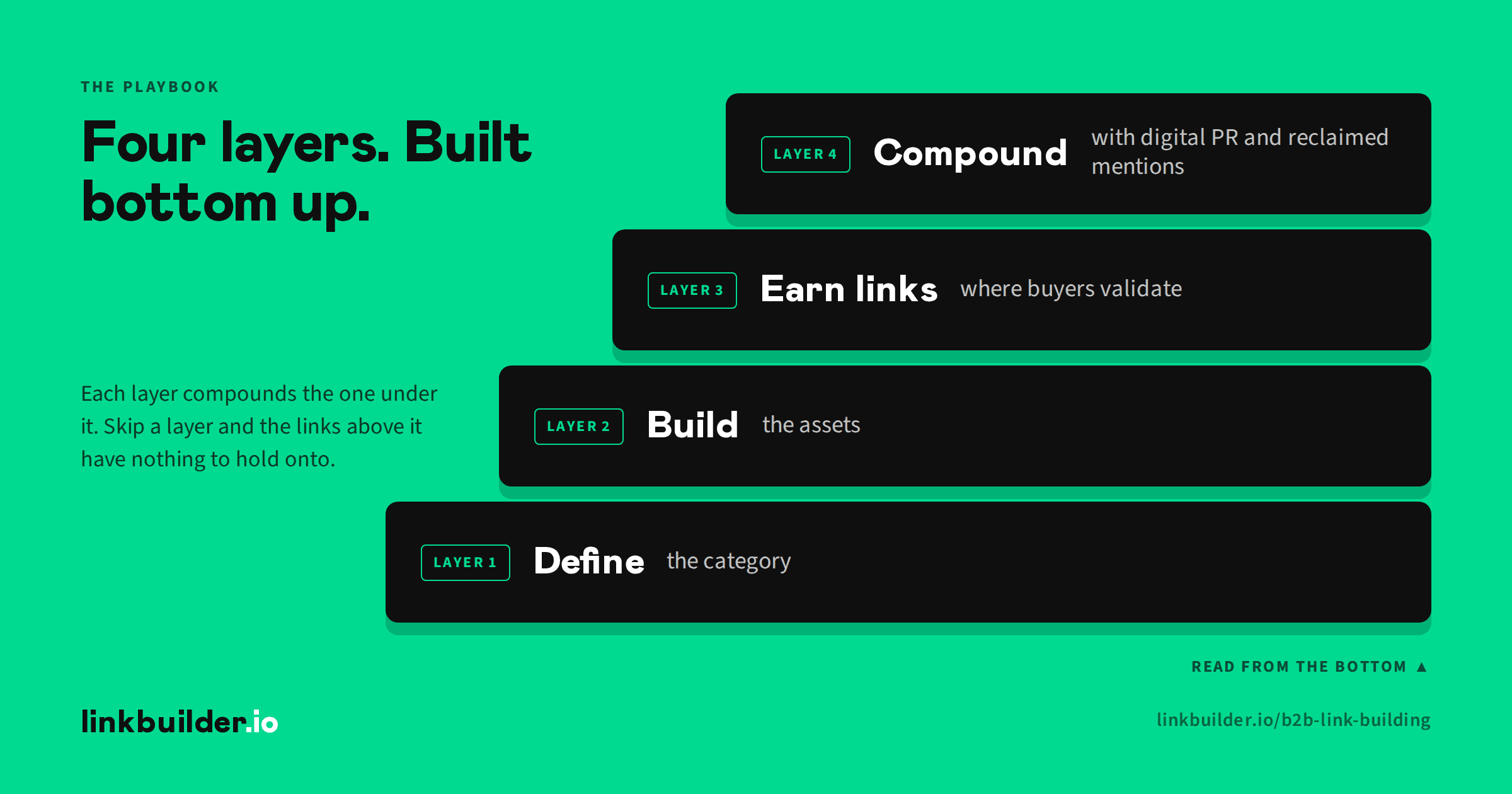
The Category Authority Playbook: Four Layers
Think of this as a stack. Each layer makes the next one cheaper and more effective.
Layer 1: Define the category you want to own
Most B2B brands describe themselves in language nobody searches for. “Revenue intelligence platform” is a positioning statement. “How to forecast pipeline more accurately” is what your buyer types.
Start by mapping the category the way a buying committee experiences it:
-
The problem language: what the CFO says in the budget meeting
-
The solution language: what the champion searches once they know a category exists
-
The evaluation language: “X vs Y,” “best tools for,” “how to choose”
-
The validation language: implementation, pricing, integration, and security questions
Then run your top five category questions through an AI assistant and note which brands and sources get cited. That’s your competitive set for authority, and it often looks nothing like your competitive set for revenue.
You’re looking for the sub-questions Google’s fan-out would generate. Those are the pages you’ll need to own, and the topics your link building will need to reinforce.
One rule for every page you build from this map: answer the question in the first two sentences. AI systems retrieve passages, not whole pages. Answer first, elaborate second.
Layer 2: Build the assets your category will cite
You can’t earn category-level links to a product page. You earn them to the resource everyone in the category ends up referencing.
For B2B, the assets that consistently attract links and citations are:
-
Original data: a benchmark report, a survey of your customer base, an analysis of anonymized platform data. This is the most reliable link magnet in B2B because journalists, analysts, and competitors all need numbers.
-
Definitive explainers: the page that finally explains a confusing concept in your category properly, with diagrams and examples. A first-hand technical breakdown from your engineering team qualifies as the “non-commodity” content Google describes. A listicle of seven tips does not.
-
Practical tools: calculators, templates, checklists, configuration guides. Trade publications link to tools because their readers use them.
-
Opinion with receipts: a clear stance on a contested question in your category, backed by your own data.
Our guide to linkable content covers formats in more detail, but the B2B filter is simple: would a procurement analyst forward this to their boss? If yes, it’ll earn links.
Here’s what that looks like in practice. One of our clients in cloud security competes against Palo Alto Networks, CrowdStrike, and Check Point, all with Domain Ratings in the mid-80s. Their blog was written by working security engineers, which made it something link partners wanted to share rather than a favor we had to ask for. We built links to their CNAPP (Cloud-Native Application Protection Platform) guide from 80 referring domains, and that single page now brings in over 2,500 organic visits a month. Across the whole site, referring domains grew from 1,405 to 5,480 and monthly organic traffic climbed from 11,893 to 47,669 visits between January 2023 and October 2024, with the client taking the top spot for terms like “cloud security software” and “container security best practices.” The full breakdown is in our cloud security case study.
The lesson: in a technical B2B category, expert-written assets are the difference between links you have to buy and links people want to give you.
Layer 3: Earn links from where your buying committee validates
This is where B2B link building diverges hardest from generic advice.
Go back to Gartner’s buying jobs. Validation and consensus creation are the moments where a champion needs external proof. So ask: where does your buyer go for proof?
For most B2B categories, it’s some combination of:
-
Trade and vertical publications: the two or three outlets your buyers read for industry news. A single editorial mention here is worth more than twenty generic guest posts.
-
Practitioner communities and newsletters: the niche newsletters, forums, and private communities where practitioners compare notes. Getting your data cited in a well-read newsletter is a link and a validation signal in one.
-
Partner and integration ecosystems: your technology partners have documentation, marketplaces, and co-marketing channels. These links are highly relevant and rarely pursued.
-
Comparison and review platforms: buyers use them during supplier selection. Make sure your listings are complete and that they link to specific pages, not just your homepage.
-
Adjacent expert sites: the consultants, implementers, and analysts who advise your buyers. Their “tools we recommend” pages are the B2B version of resource pages.
The outreach is different too. You’re not pitching “here’s a guest post.” You’re pitching “here’s data your readers will use,” or “here’s a technical explainer that answers the question your audience keeps asking.” Guest posts still have a place in B2B (our guest posting guide covers how to do them well), but the placement has to be somewhere your buyer would find credible.
One test we use: if the buyer’s CFO looked up the site that linked to you, would it help the deal or hurt it?
Layer 4: Compound with digital PR and reclaimed mentions
Once you have assets and relationships in the category, two multipliers kick in.
Digital PR. Campaigns built on your original data can generate dozens of placements from a single story, and those placements tend to come from higher-authority outlets than outreach alone reaches. In B2B, the campaigns that work are the ones tied to your category’s real questions: a salary benchmark, an adoption survey, a cost-of-downtime analysis. Our digital PR services are built around exactly this kind of data-led story.
Reclaimed mentions. As your category authority grows, you’ll get mentioned without a link. Publications will reference your data, podcasts will name-drop you, and partner blogs will describe your product. Our unlinked mentions guide walks through turning those into links. This is the lowest-cost link building you’ll ever do, and it compounds every quarter.
Both multipliers also feed AI visibility directly. More trusted sources talking about you means more corroboration for the assistant.
How to Measure Category Authority
Link count is an input. These are the outputs worth tracking:
-
Referring domains from category-relevant sites, not total referring domains. Segment by the publication list you built in Layer 3.
-
AI citations for your category questions. Run the same five prompts monthly and record which sources get cited. Google Search Console now includes a Generative AI performance report that shows which of your URLs appeared in AI features.
-
Rankings for category sub-questions, not just head terms.
-
Branded search volume as a lagging indicator. Buyers who saw you cited go and search for you.
-
Linked mentions in trade press over time.
Our generative engine optimization guide covers the AI-side measurement in more depth.
Where LinkBuilder.io Fits
We’ve spent years building links in technical B2B categories: cloud security, database performance, IT infrastructure, fintech, FP&A software. The pattern in every one is the same. The brands that win aren’t the ones with the most links. They’re the ones with the right links, to the right assets, from the places their buyers trust.
Our managed link building service runs the full stack in this playbook: category mapping, asset strategy, outreach to the publications your buyers read, and reporting that shows category-relevant referring domains rather than a vanity total. If you want to see what that looks like for your category, book a call or take a look at our pricing.
FAQ
What is B2B link building?
B2B link building is earning links and citations from the websites, publications, and communities that business buyers trust, so your brand appears when they research a category. Unlike consumer link building, it prioritizes relevance to a buying committee over raw traffic.
How is B2B link building different from B2C?
B2B purchases involve a group of stakeholders working through multiple research and validation steps over a longer period. Links need to appear in the sources those stakeholders use to validate a decision, such as trade publications and expert sites, rather than in high-traffic general outlets.
How many backlinks does a B2B company need?
There’s no fixed number. The useful measure is referring domains from category-relevant sites pointing to assets that answer your buyers’ questions. A B2B brand with a few hundred highly relevant referring domains typically outperforms one with thousands of unrelated ones, both in rankings and in AI citations.
Do backlinks help with AI search visibility?
Yes. Google’s generative AI features retrieve grounding content from its search index, so pages that rank through link authority are the pages eligible to be cited. Links from trusted sources also give AI systems the corroboration they need to name a brand with confidence.
What is category authority?
Category authority is when search engines, AI systems, and buyers consistently associate your brand with a specific problem space. It’s built by owning the key questions in a category, publishing assets others cite, and earning links from the sources your buyers trust.
Own the Category, Not Just the Keyword
B2B link building has always been about trust. What’s changed is that the trust now has to be legible to an AI assistant as well as a buying committee, and both are looking for the same thing: multiple credible sources pointing at the same brand for the same category.
Build the map, build the assets, earn the links from where your buyers validate, and let digital PR and reclaimed mentions compound it. That’s the playbook.
If you’d rather have a team that’s run it across dozens of B2B categories do it for you, let’s talk.

Erika
Head of Link Operations